SHORT ANSWER
Yes—in the carefully defined sense of biological tissue expansion. Long-term mechanical expansion can produce genuine additional human skin tissue, not merely hold skin in a temporarily stretched position. Limited direct evidence also indicates that nonsurgical restoration can increase penile skin coverage in at least some adults. Restoration-specific effectiveness and dosing, however, are not well quantified.
EVIDENCE SUMMARY
How strong and direct is the evidence?
Stretch and growth are not the same event
Skin changes shape as soon as a load is applied. That immediate deformation reflects elastic and time-dependent mechanical behavior: tissue lengthens or shifts under tension, then may partly return after the load is removed. A temporary change in position does not show that new tissue has formed.
Biological tissue expansion is slower. Cells respond to sustained mechanical conditions, cell populations change their activity, and the extracellular matrix remodels. Reconstructive medicine deliberately uses this capacity to create additional skin for repair. Histological work in expanded human skin reported increased mitotic activity—evidence of cell division rather than passive stretch alone [1]. Longer-term human histopathology has also examined how expanded skin adapts over time [2].
In this article, “new skin” means a net increase in living tissue area produced through biological growth and remodeling. It does not mean that an entirely new anatomical organ appears or that removed specialized structures regenerate.
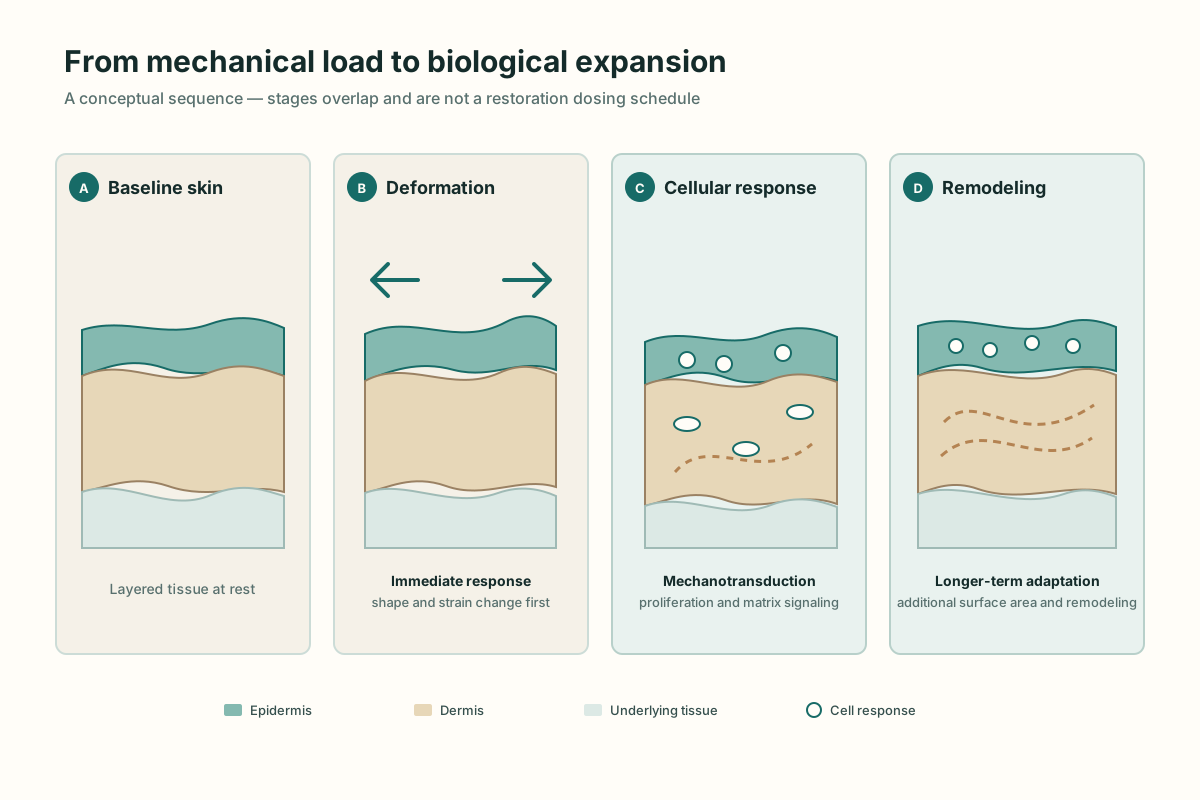
What happens during biological skin expansion?
Skin is not a uniform sheet. Its outer epidermis, supporting dermis, blood supply, extracellular matrix, nerves, appendages, and immune cells must function together. Expansion research describes coordinated changes rather than one simple “stretch response.”
- Mechanical loading changes cell conditions
Cells sense deformation and altered forces through mechanotransduction pathways. This provides signals that can affect proliferation, differentiation, and matrix production.
- Epidermal cells increase production
Experimental studies show changes in epidermal stem-cell behavior during expansion. These findings help explain how surface area can increase without remaining permanently thinned.
- The dermis remodels
Fibroblasts alter proliferation and extracellular-matrix programs. Recent animal mechanistic research identified stretch-responsive fibroblast states that coordinate with epidermal stem cells [3].
- The expanded tissue adapts
Vascular and structural adaptation must support the larger living tissue area. The details depend on tissue, loading geometry, duration, and experimental or clinical context.
Human-adjacent evidence supports the mechanism
Human reconstructive expansion studies and reviews provide the strongest basis for saying that human skin can grow under sustained expansion. Single-cell analysis of human skin from clinical expansion therapy has described cell populations and regulatory programs associated with long-term mechanical expansion [4]. Mechanobiology reviews likewise distinguish acute elastic response from chronic growth [5].
This evidence is adjacent to foreskin restoration, not equivalent to it. Reconstructive expanders, anatomical locations, loading patterns, clinical supervision, and intended outcomes differ from manual or wearable penile-skin practices. It establishes biological plausibility and general human capacity; it does not tell a restorer which method works best or how much loading to use.
What direct restoration evidence adds
A prospective referral cohort followed 11 adults seeking foreskin reconstruction consultation. The report documented increased glans-covering penile tissue among some participants practicing long-term nonsurgical tension [6]. That makes it more directly relevant than general skin-expansion research.
It is still a very small and limited study. Participants used heterogeneous practices, there was no control group, tension exposure was not standardized, and the study did not use a validated objective outcome scale. It cannot estimate an average success rate, compare methods, identify a dose-response relationship, or predict an individual timeline.
Do not turn one cohort into a protocol
Duration and coverage observations from 11 referred participants are descriptions of that cohort. They are not a validated schedule and should not be converted into “years to finish,” hours per day, or a recommended force.
Why tissue-expansion biology does not prove a device
A mechanism can be real while a particular implementation remains untested. A restoration device changes more than “tension”: contact area, pressure distribution, gripping method, geometry, movement, duration, ability to monitor circulation, and user adherence all affect exposure. General expansion research does not verify those characteristics for any future Foreskin Online product or any other device.
Nor does evidence of growth establish that more force produces faster growth. Loading beyond tissue tolerance can cause compression, impaired circulation, irritation, tears, or other injury. Restoration-specific studies have not defined a scientifically optimal force, pressure, weight, or daily duration.
What we know—and what we do not
What we know
- Human skin can gain tissue area during long-term reconstructive expansion.
- Expanded human skin shows biological activity consistent with growth and remodeling.
- Animal and human-adjacent studies identify epidermal, dermal, and matrix responses.
- A small direct cohort documented increased penile skin coverage in some adults.
What we do not know
- Average restoration effectiveness across a representative population
- The best method or device design
- A validated universal tension dose or schedule
- Predictable individual timelines
- Restoration-specific complication rates
- Whether every apparent short-term change represents lasting tissue growth
The responsible conclusion
Long-term mechanical expansion can produce genuine additional skin tissue in humans generally. Limited direct evidence indicates that nonsurgical restoration can increase penile skin coverage in at least some adults, but restoration-specific effectiveness and dosing are not well quantified. Calling the process “only stretching” ignores established tissue-expansion biology; calling it clinically proven foreskin regrowth goes beyond the evidence.