SHORT ANSWER
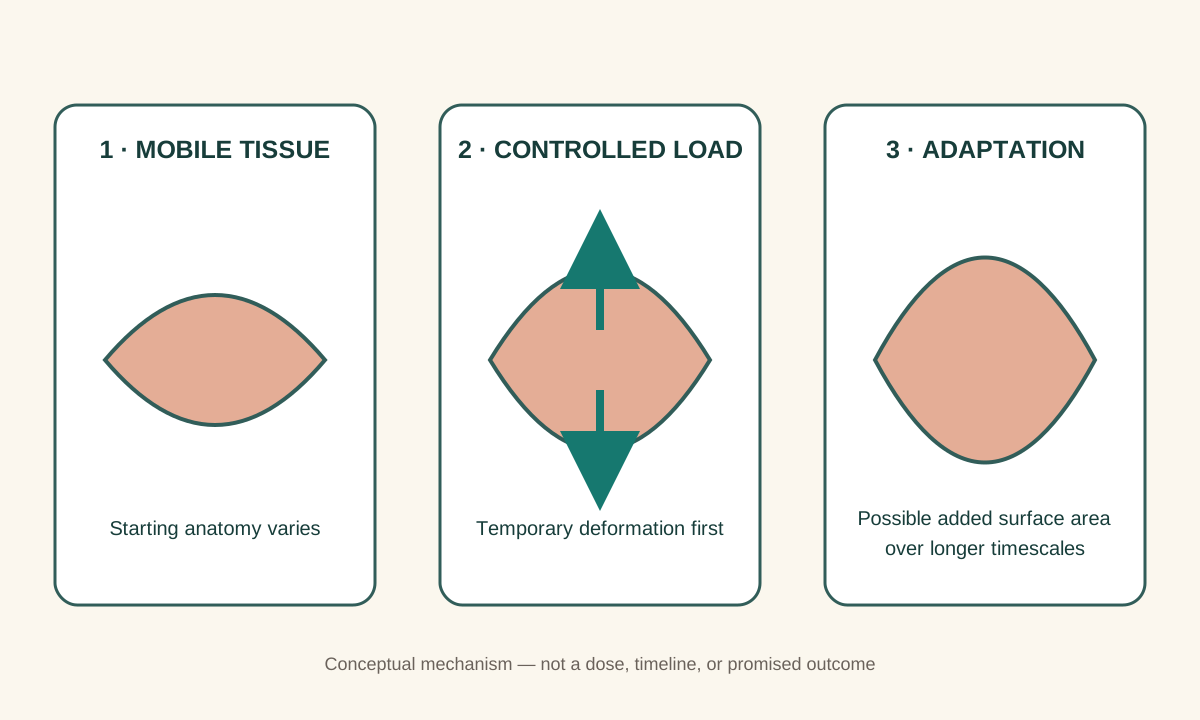
Foreskin restoration uses repeated, controlled mechanical loading of skin and mucosal tissue remaining after circumcision. Over time, living skin can respond through cellular proliferation and structural remodeling, increasing the amount of available tissue and potentially allowing more glans coverage. This is tissue expansion—not literal regeneration of the exact original foreskin.
EVIDENCE SUMMARY
How strong and direct is the evidence?
Restoration begins with tissue that remains
Circumcision outcomes vary. The location of the scar, distribution of mobile shaft skin, amount of inner mucosal tissue, frenular remnants, and baseline coverage are not identical between people. Nonsurgical restoration does not add a foreign tissue type; it applies loading to available tissue with the aim of increasing its area.
Community language often divides tissue into “inner” and “outer” skin. That shorthand can help describe placement, but it should not be treated as proof that a method selectively grows one tissue compartment. No restoration trial has established precise tissue selectivity for manual, dual-tension, inflation, tugging, or weighted methods.
Controlled mechanical loading supplies the stimulus
Manual techniques and devices differ in how they create and distribute load. Hands can apply tension for discrete sessions. Tape may hold tissue or connect it to a directional load. Tugging systems use a strap or anchor. Dual-tension designs create opposing forces. Inflation uses internal air pressure, while weights use gravity.
Despite different mechanics, the proposed biological link is mechanical loading. Force alone does not describe the exposure. Contact area, tissue geometry, duration, movement, gripping pressure, recovery, and circulation also matter. No universal restoration dose has been scientifically validated.
“Controlled loading” means an exposure that can be applied, monitored, and stopped. It does not imply that research has identified an optimal force or schedule.
Immediate deformation comes before long-term adaptation
When skin is pulled, it deforms immediately. That change can include elastic extension, tissue movement, and time-dependent creep. Much of an immediate visual change may reverse after the load is removed. Temporary positioning, fluid-related swelling, or compression marks are not evidence of new tissue.
With sustained expansion in reconstructive contexts, the response can progress beyond deformation. Human histology has reported mitotic activity in expanded skin [1], and longer-term tissue studies describe histopathological adaptation [2]. These findings establish that human skin can grow and remodel under expansion.
The epidermis and dermis respond together
The epidermis forms the outer barrier. The dermis provides structural support through fibroblasts, collagen, elastin, extracellular matrix, vasculature, and other components. A larger durable skin surface requires coordinated adaptation rather than indefinite thinning.
- Cells detect changed mechanical conditions
Mechanotransduction converts physical conditions into cellular signals.
- Epidermal production changes
Experimental expansion studies identify altered stem-cell activity and increased production of epidermal cells.
- Living tissue adapts structurally
Extracellular matrix and vascular support must adapt to a changed tissue area. This is biological remodeling, not passive material extension alone.
Why coverage may increase
If the amount of available penile skin increases, more tissue may be able to move toward or rest over the glans. A small prospective cohort documented increased glans-covering tissue among some adults practicing long-term nonsurgical restoration [5]. That observation is directly relevant, but the cohort contained only 11 referred participants and did not standardize methods or dose.
Coverage also depends on anatomy and conditions. Flaccid size, temperature, posture, movement, tissue distribution, and skin mobility can change appearance. A coverage label therefore cannot by itself prove how much tissue was produced.
Expansion is not embryological regeneration
The original foreskin develops through coordinated embryological and fetal processes. It includes specialized tissue organization, innervation, blood supply, mucosal and cutaneous surfaces, and frenular anatomy. Developmental studies describe this original formation and innervation [6].
Adult tissue expansion does not rerun development. It expands tissue that remains. The resulting tissue may provide additional coverage and mobility, but evidence does not show that it recreates all removed nerves, a completely removed frenulum, or the exact original architecture.
Functional restoration can mean regaining some coverage or mobility. Anatomical reproduction would mean recreating the exact removed structures. Evidence supports the possibility of the former in some adults, not the latter.
Manual and device approaches are mechanisms, not proven rankings
Different approaches may be more or less practical for a particular routine, but convenience is not effectiveness. A person may value direct control, concealment, easy removal, hands-free wear, or freedom from adhesives. Those considerations can guide a choice without asserting that one category grows tissue faster.
The 2022 restoration review found sparse and heterogeneous medical literature. Routines reproduced from community or manufacturer sources remain descriptions rather than validated prescriptions [7].
What we know—and what remains uncertain
What we know
- Human skin can undergo biological expansion.
- Expansion involves epidermal and dermal responses.
- Restoration loads remaining tissue rather than recreating removed tissue from nothing.
- Limited direct evidence documents increased coverage in some adults.
What we do not know
- A universally effective method
- An optimal force or daily duration
- A predictable timeline
- Average complication rates
- Whether specific methods selectively expand specific tissue types
- Whether expanded tissue reproduces original neural architecture
A practical model without overclaiming
The most defensible model is straightforward: a manageable mechanical load is repeatedly applied to available tissue; living skin can adapt through growth and remodeling; and additional tissue may permit increased coverage. Each arrow in that model has limits. General biology is stronger than direct restoration evidence, and neither supplies a universal protocol.