DIRECT ANSWER
“Inner skin” and “outer skin” are useful community terms for different visible regions of remaining penile skin. They are not exact histological labels, and there is no clinical evidence that a restoration method can grow only one region or that one region has an ideal proportion.
EVIDENCE SUMMARY
How strong and direct is the evidence?
What restorers usually mean
“Outer skin”
Usually means hair-bearing or nonmucosal-type shaft skin on the external surface. The exact transition varies and may be altered by a circumcision scar.
“Inner skin”
Usually means residual preputial tissue between the scar region and the glans. It may differ in appearance and surface environment from shaft skin, but community labels do not map perfectly onto microscopic boundaries.
Developmental and histological research describes specialized preputial anatomy and innervation [1] [2]. Those studies establish anatomy; they do not validate restoration targeting claims.
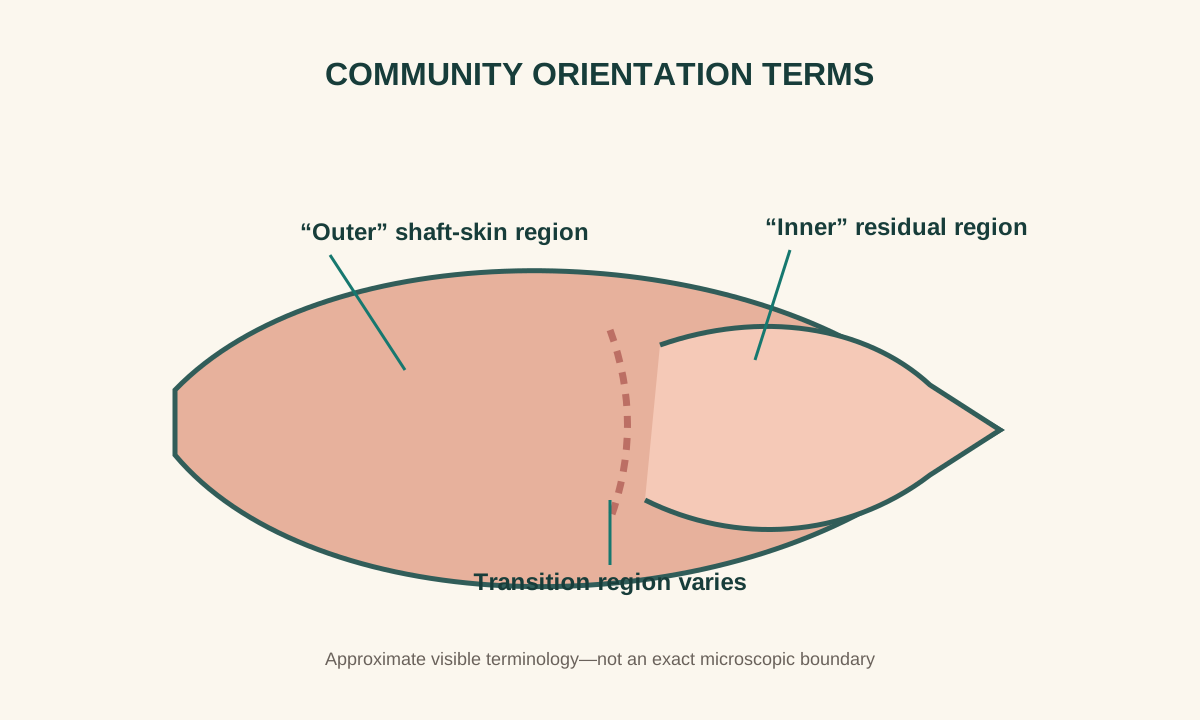
Why residual anatomy differs
Circumcision removes different amounts and distributions of tissue. Scar position, mobility, shaft-skin availability, residual frenular tissue, and the amount of tissue near the glans can therefore differ substantially. That starting anatomy can affect appearance, attachment options, and how skin moves during loading.
Visible color or texture is not a reliable substitute for histology. A person may also use the same community term differently from another person.
Loading a region is not proof of selective growth
Hand placement or device geometry can change where force, contact pressure, or strain is felt. That makes regional mechanical emphasis plausible. It does not demonstrate that only that tissue is loaded, that the biological response is confined to it, or that one tissue grows faster.
General skin-expansion biology supports growth and remodeling under sustained expansion [3]. It does not establish a clinically selective penile-skin protocol.
Practical interpretation
- Describe the region and landmark rather than assuming a universal label.
- Consider mobility, comfort, contact area, and circulation—not only where tension feels strongest.
- Avoid pursuing an unsupported “ideal ratio.”
- Treat pain, numbness, marked discoloration, or injury as reasons to stop.