DIRECT ANSWER
The Coverage Index, usually shortened to CI, is community-created shorthand for describing approximate foreskin or restored-skin coverage. It is not a diagnosis, a clinically validated outcome scale, or a precise linear measurement of tissue growth.
EVIDENCE SUMMARY
How strong and direct is the evidence?
Why communities use coverage terminology
Coverage is visually complex to describe in ordinary language. A shared scale gives people a compact way to discuss an approximate starting appearance, current appearance, or personal goal. It can also provide context for questions about fit, mobility, or methods.
The usefulness is communicative, not diagnostic. A CI label does not establish health, function, sensation, tissue quality, or whether a method is working safely.
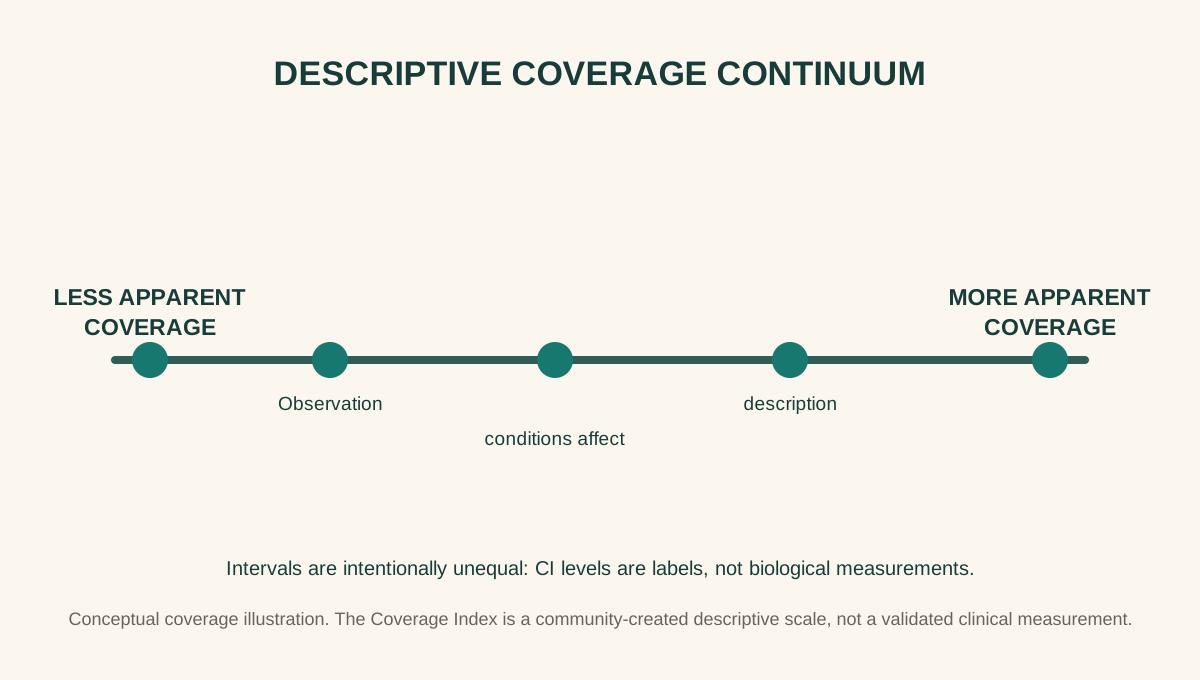
What a CI description usually refers to
Coverage systems generally move from little or no apparent glans coverage toward partial and then greater coverage. Some variants distinguish flaccid and erect observation or add more detailed labels. Foreskin Online does not reproduce third-party photographic charts, and it does not claim one variant as a medical standard.
A CI description is best read as an approximate appearance category under stated conditions—not a measurement in millimeters, tissue area, or biological growth rate.
Flaccid and erect observations are different
Flaccid appearance can vary considerably within the same person. Temperature, stress, activity, posture, and natural changes in penile size alter the relationship between available skin and the glans. An erect observation may be more repeatable in some respects, but erection firmness, angle, and tissue distribution still vary.
A label without the observation context loses information. Someone comparing notes should state whether the description was flaccid, erect, seated, standing, immediately after device removal, or observed after recovery.
Why apparent coverage varies
Cold and warmth can temporarily change tissue position and flaccid dimensions.
Sitting, standing, bending, and lying down can shift visible coverage.
Activity and clothing contact can move available tissue.
Glans shape, shaft dimensions, scar position, and tissue distribution differ.
Tissue can move without a corresponding change in total quantity.
Boundaries between informal categories are subjective.
CI intervals are not proven equal
A numbered scale can look mathematical even when its categories are descriptive. There is no evidence that moving between two neighboring CI labels requires the same increase in tissue as moving between another pair. Some visual transitions may depend on anatomical thresholds, such as tissue beginning to rest at a new position.
Because the intervals are not validated equal units, averaging them or treating them like centimeters can be misleading.
Why “one CI per year” is not scientific
Community members sometimes summarize personal experience as a number of CI levels over time. Such reports may help illustrate that restoration is long term, but they do not create a validated progression rate.
The numerator is subjective and nonlinear. The denominator may omit changes in routine, interruptions, starting conditions, or how observations were made. Participants are self-selected, and people with different experiences may be more or less likely to report them. No direct study establishes a universal CI-per-year schedule.
Do not convert the 11-person cohort into a CI timeline
The direct cohort documented coverage observations in a small, heterogeneous referral group [1]. It did not validate CI as a linear outcome or produce a predictive annual rate.
Use more than one progress observation
- Describe conditions
Record posture, temperature, erection state, and whether the observation followed recent loading.
- Use a range when appropriate
A range can be more honest than forcing a fluctuating appearance into one exact category.
- Track comfort and skin condition
A visual label must never outweigh pain, numbness, discoloration, wounds, or other warning signs.
- Record routine context
Note method changes, interruptions, irritation, and adherence without turning them into a dose prescription.
- Compare at longer intervals
Short-term movement can obscure gradual trends.
- Protect privacy
Store sensitive notes or images securely. This site does not accept progress uploads.
What CI cannot measure
CI can help describe
- Approximate apparent coverage
- A visual reference under stated conditions
- Community discussion context
- A personal appearance goal
CI does not establish
- Tissue area or growth rate
- Health or circulation
- Sensation or sexual function
- Method effectiveness
- A medical diagnosis
- A predictable completion date
What we know—and what we do not
What we know
- Coverage terminology helps communities communicate.
- Apparent coverage changes with observation conditions.
- Different scale variants and interpretations exist.
- A label can be one part of private progress documentation.
What we do not know
- Whether CI categories correspond to equal tissue increments
- The measurement reliability between observers
- A validated CI-per-year rate
- Whether CI predicts comfort, function, or satisfaction
- How accurately a label reflects biological tissue growth
The most useful way to use CI
Treat it as approximate language, name the conditions, accept uncertainty, and combine it with other observations. CI can organize a conversation; it cannot turn an individually variable process into a clinical measurement or clock.